Report by Alan
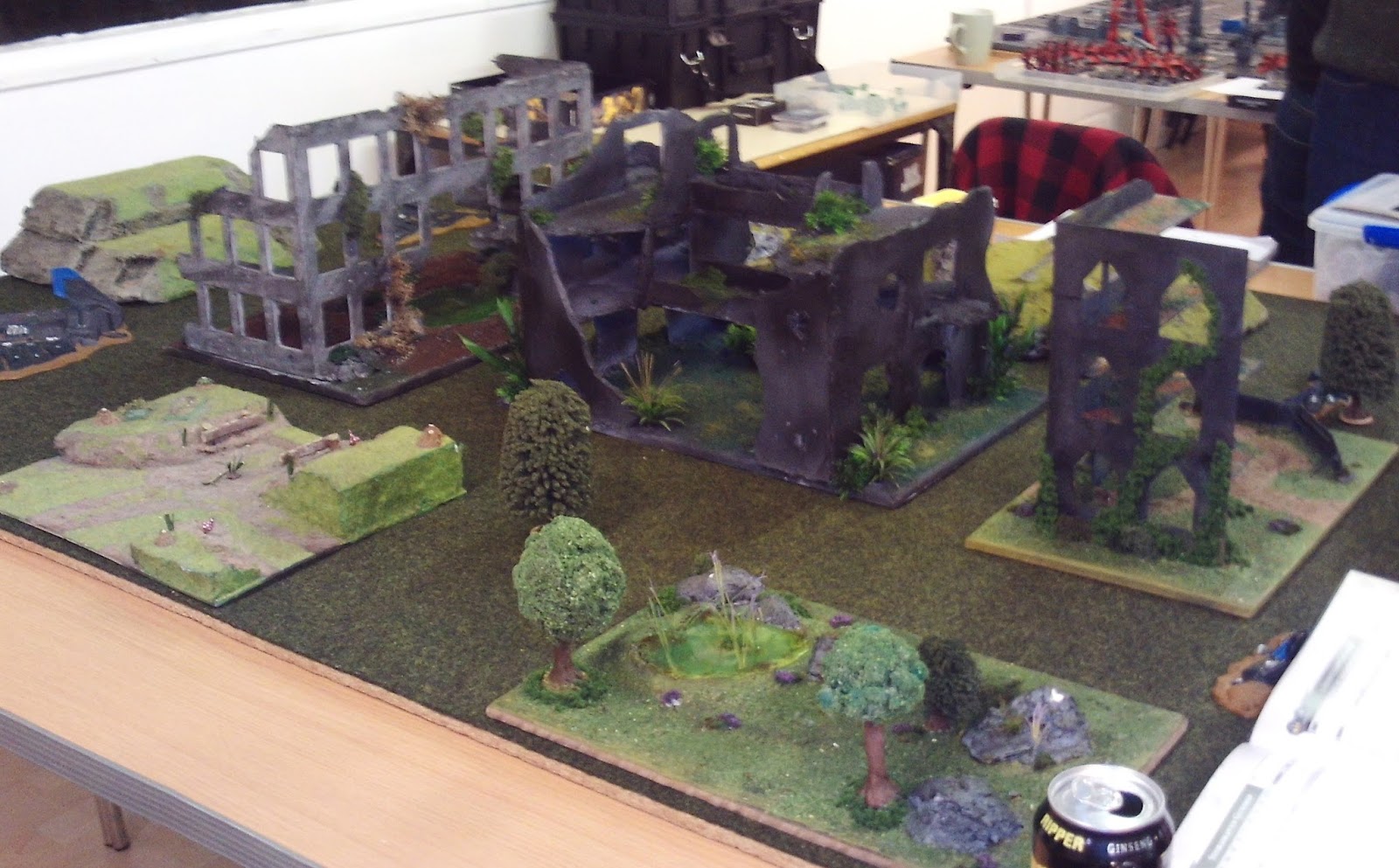
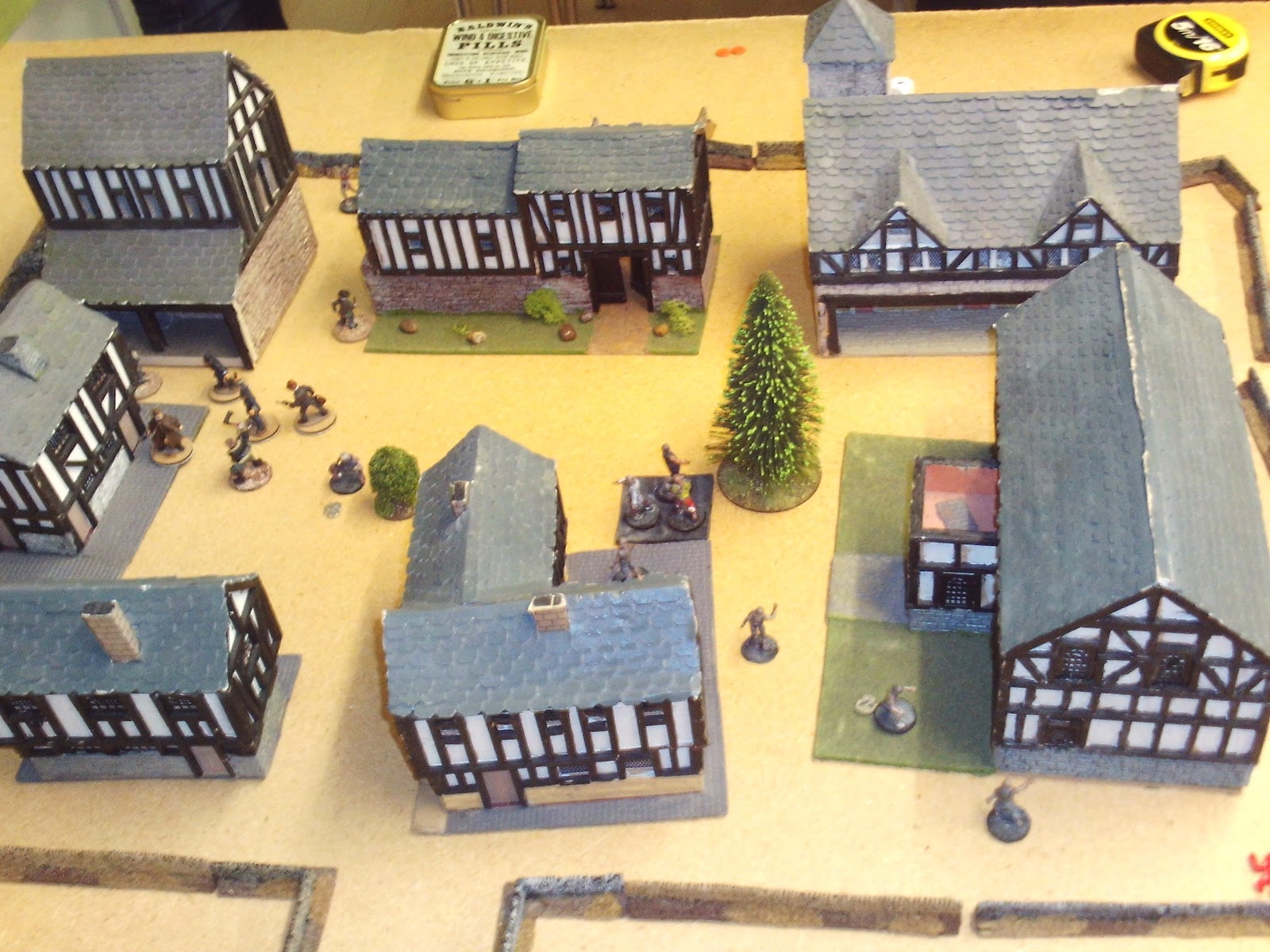
Our club Games Day in October 2017 saw us re-enact a battle from our study of the American Civil War’s western theatre. Five of us participated in a re-enactment of the battle of Corinth, which occurred on Oct 3-4, 1862, in north-eastern Mississippi. We used 15mm figures, terrain from a mix of sources, and the Fire & Fury rules.
We had re-fought the battle of Iuka a couple of weeks previously, at our regular Friday meeting. In that battle, the historically-aggressive Confederate initial attacks had been something of a damp squib, allowing the Federal side to make early gains. Although the battle evened out and then see-sawed back and forth as each side’s reinforcements arrived, it was clear by the end of the battle that the Rebels, despite having done much better than historically in terms of casualties, were in danger of being trapped, as Union forces closed in on their escape route.
 |
1 – The crew for the re-enactment of Corinth
L to R, Colin, Alan, Kieron, Ian, and Bill |
Historically, the Confederates under Sterling Price had evaded this trap, allowing them to link up with other Confederate forces under Earl Van Dorn a few days later. The Confederates were under orders to prevent reinforcements from Ulysses Grant’s and William Rosecrans’ Union armies being sent to aid Northern efforts in Kentucky, so Van Dorn, now in command of all Confederate forces in Mississippi, came up with an elaborate plan to strike north into Tennessee and isolate Rosecrans, who was guarding the important Federal supply depot at Corinth.
Our game therefore began with the historic poorly-coordinated Confederate attacks at 10am on the rifle pits north of the town, and it was soon clear that the Rebels were intent on revenge for Iuka; Lovell’s Mississippi Divn immediately attacked McKean’s Divn on the Union left flank, hurling it back in disorder. Abysmally poor Federal dice throwing soon saw an undamaged brigade skedaddle the field without firing a shot! Their left, already undermanned, was suddenly up in the air, and the Rebels were quick to exploit the weakness.
 |
| 2 – The strong assault by Lovell’s Divn on the Union left |
To add insult to injury, the remainder of the Federal left flank now came under attack by the Confederate Maury’s Division, the next to arrive in the poorly coordinated Rebel plans.
 |
| 3 – Maury’s Division attacks the Federal rifle pits |
Once again however, disastrous Federal dice throws saw the Union defenders thrown back from the front-line rifle pits, after inflicting only minimal losses on the attackers. It was not yet 11.30am battle time, and the Confederates had already all but destroyed the Union left flank, and captured the rifle pits facing their right for virtually no loss.
It was about to get still worse for the Federals. As Davies’ Divn in their centre prepared to face the onslaught from Hebert’s Rebels, they could not ignore Maury’s Divn, which was now also pressing in on their left. The Federal centre was about to get rolled up by overwhelming numbers in a combined frontal and flank attack.
 |
| 4 – Maury’s Divn starts to roll up the Federal centre |
Over on the Federal left, Lovell’s Divn continued to make spectacular advances for the Confederates, with their attached cavalry brigade taking out a Union battery, leaving them uncontested in the centre of the field.
It wasn’t going entirely the Confederates’ way, though. All of the work thus far by Lovell’s Divn had been achieved by just two brigades and their cavalry; their Louisiana Zouave battalion steadfastly refused to get engaged. Moreover, the remnants of the Federal left were putting up an increasing stiff opposition, and their one surviving brigade, together with some of their divisional artillery, finally succeeded in stemming the tide of the Confederate infantry assault on that flank.
 |
| 5 – The Confederate attack on the Federal left runs out of steam |
Bad luck with the dice continued to dog the Federal efforts however. By 12 noon, Davies’ Divn in the Federal centre was fully engaged. Hackleman’s Brigade, outnumbered almost 3:1, made a gallant stand supported by some of their divisional artillery, but it was in continued danger of being flanked from its left, and eventually it was also forced back from the rifle pits.
 |
| 6 – The Federal centre makes a brave stand |
At 12.30pm battle time, the Federals got almost their only good news of the day. With the Louisiana Zouave battalion apparently too timid to fight, Lovell’s Divn on the Confederate right was short of reserves and unable to press its attack. Their attached cavalry had gone off on a wild ride through the woods, looking for the Federal centre, so the remnants of McKean’s Divn were able to stabilise the Federal left, and the action on that flank ground to a halt.
Over in the centre however, it was a very different story. By 1pm battle time, Davies’ Divn defending the Federal centre had been forced back, and the remnants were facing overwhelming odds in a desperate effort to stave off a complete Confederate break-through. As the Rebels advanced, Hamilton’s Divn on the Federal right also faced being flanked on its left, and was forced to pull back to conform to the rest of the Federal line, such as it was.
 |
7 - The Federal centre-faces overwhelming odds
to prevent a break-through |
By 2pm battle time, it was all but over. Federal dice-throwing throughout the game had been abysmal, and the Confederates had successfully taken advantage of it to roll up the Union forces in detail.
Of the ten infantry brigades the Union forces started with, six had been virtually destroyed, along with three artillery batteries. Confederate losses had been a small fraction of their opponents’, and virtually the only thing standing between the Confederates and their objectives of the town of Corinth and its crucial railroad junction, was the remaining Federal artillery, Stanley’s two-brigade division which had been posted in the earthworks west of the town, and the two brigades of Mizner’s cavalry division, which had dismounted to defend the abatis just north of town.
Under the circumstances, the Federals were obliged to concede a complete victory to their opponents. Not only had the Confederates achieved a stunning victory which completely reversed the verdict of history (and in a single day, instead of two), they had moreover done so with far fewer losses than in reality.
If this had been the historical outcome of the battle, then the impact on the war effort, both north and south, would have been immense. We can speculate that Van Dorn, by effectively destroying Rosecrans’ army, would have completely changed the Federal fortunes in western Tennessee. Although the Federals still had more men in the field, they were widely scattered, defending supply bases and communication routes. At the least, Ulysses Grant would have been compelled to look to his own defences, leaving Buell to defend himself as best he could in Kentucky.
And that raises a most interesting what-if for us to ponder. Could a stunning success at Corinth have inspired Braxton Bragg to produce another one at Perryville in Kentucky five days later? Two military successes in the west might have done much to nullify the effects of Robert E Lee’s strategic defeat at Antietam and the end of his Maryland campaign in September, and with it Lincoln’s issuance of the Emancipation Proclamation, which effectively ended any hope of foreign recognition for the Confederacy. Both Britain and France were on the verge of proposing mediation and an arbitrated settlement prior to Antietam, so the potential consequences of further Confederate military victories at this point in the war will always be rich pickings for historians to consider.
One thing is certain – the Confederate campaigns in Maryland, Mississippi, and Kentucky in Sept-Oct 1862 were the closest they ever came to coordinated combined operations. Grant, at least, saw the significance, and he sought to emulate it when he became Union Commander-in-Chief in 1864.
Historically, the triple failure at Antietam, Corinth and Perryville in the fall of 1862 sealed the Confederacy’s fate, although its significance certainty wasn’t recognised then. Even today, the Iuka – Corinth and Kentucky Heartland campaigns are considered secondary, almost a backwater, when compared to the war in the east.
Perhaps at the time, that myopia was understandable. The capitals were in the east and barely 100 miles apart, the eastern states were the most populous, and the brilliance of Confederate leaders like Robert E Lee and the sheer dogged persistence of the Union Army of the Potomac, captured the attention of all who read about them.
However, a century and a half of hindsight lend us a different perspective. With conflict in the east so often at a stalemate, the Union had to prevail in the west in order to win. The fact that they did so, almost from the beginning, was hardly recognised at the time. The Confederacy simply never had the manpower or resources to defend the vast distances of the western theatre, so it lost in campaign after campaign, and was obliged to surrender territory at almost every stage.
By mid-1862, the Confederate heartland was being penetrated by Union gunboats patrolling the major rivers; by mid-1863, it was literally split in two, following the capture of Vicksburg; by mid-1864, Sherman was at the gates of Atlanta.
It was Winfield Scott’s Anaconda Plan brought to life, and it was most successful in the west, where the Confederacy was always at its weakest.